Banned and Recovered: Artists Respond to Censorship
November 3, 2008
On any other Election Eve, with all the deserved focus and attention on getting out the vote, I’d be nearly embarrassed to bring up the relatively trivial subject of a little ol’ art show that I happen to be in. But this isn’t any little show, nor is it trivial. In fact it’s so relevant to the election that I wished I’d posted it earlier. It’s titled “Banned and Recovered: Artists Respond to Censorship,” shared by two Bay Area venues: The San Francisco Center for the Book and the African-American Museum and Library at Oakland. The show’s central theme is banned literary works but the title’s operative word is Censorship, which extends from First Amendment topics to civil liberties issues and beyond. Food for thought on this very significant Election Day.
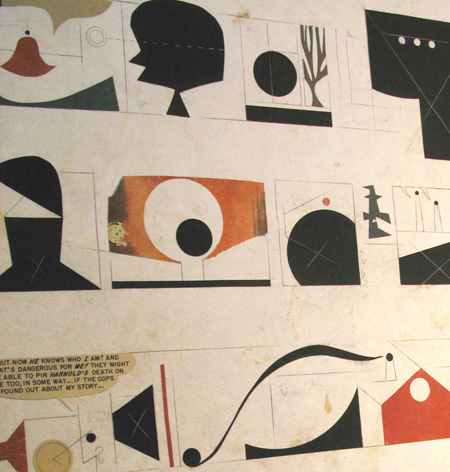
'Comics Code' (detail) on view in Oakland.
Photograph by Douglas Sandberg.
My contribution to the show is titled “Comics Code,” a cut-paper collage with graphite on Mexican bark paper. The comics I read as a kid bore an official-looking seal on their covers stating approval by the Comics Code Authority. I later learned that the seal originated from the Senate Subcommittee on Juvenile Delinquency hearings in 1954, intending to regulate content deemed harmful to young readers. My piece addresses the Code’s restrictions that ‘sanitized’ the industry to the extent that it put most of the comic titles of the time out of business, which I symbolized by fading the imagery out progressively towards the bottom.
My piece, which can be seen in full on this site’s Works category, draws on EC Comics for its source material. In fact, of all eight of the word balloons comes from a single page of Crime SuspenStories that reads like a metaphor for the impending demise of the genre. (I’ll soon add a hi-res file large enough to read.) The title “Comics Code” works as a double entendre in that it also refers to the iconic visual vocabulary of comics (think ‘speed lines’ and ‘thought balloons’). The notion of such abstract symbols having become universally accepted and understood interests me as much as the tales they tell. Comics are modern-day glyphs, and I arranged my elements compositionally to make that analogy.
“Comics Code” is not an indictment of Dr. Fredric Wertham, whose infamous testimony dealt publishers their final blow at the Hendrickson hearings. (Regardless of Wertham’s views, I support his exercising his First Amendment rights.) Nor is it a judgement call on the content in question. (Clearly much of it was violent.) Nor is it about McCarthyism per se (Communism was not among the charges, as Louis Menand points out in this excellent New Yorker book review), but we’re getting warm. It’s about climates of surveillance encouraging self-censor-ship and environments that deem it unpatriotic to speak out. It’s about lack of due process (First Amendment rights don’t get you far in kangaroo court proceedings — which the Hendrickson hearings are compared to) and about promoting divisiveness in the name of democracy. Personally, my democratic ideals don’t jibe with slogans like “you’re either with us or against us,” and “the real America” to the exclusion of alternate opinions.
To proponents of such doctrines, “Comics Code” answers: No thanks, I’ll be voting with “the other folks” for the restoration of inclusiveness, tolerance, justice, and civil liberties.
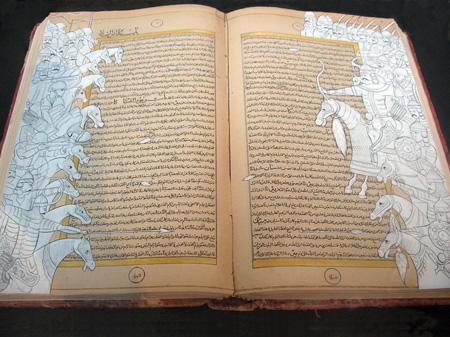
Ala Ebtekar's 'Bound Chasm' at the SFCB.
Among my favorites of the exhibition’s sixty or so pieces are Enrique Chagoya’s “Double Portrait of William Burroughs,” Nigel Poor’s “Washed Books,” and Ala Ebtekar’s “Bound Chasm,” all at the San Francisco half of the show, up till November 26 at the S.F. Center for the Book, 300 DeHaro Street (entrance on 16th Street). Gallery hours: M-F 10-5; Sat 12-4.
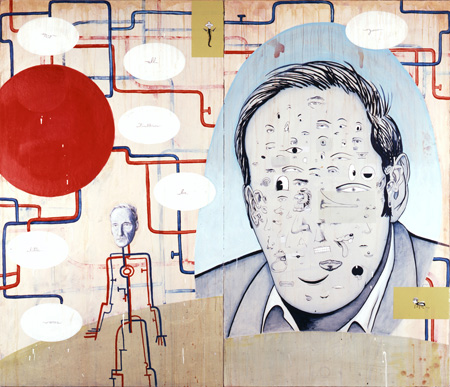
Enrique Chagoya's 'Double Portrait of William Burroughs' at the SFCB.
My piece is at the African American Museum and Library at Oakland, a majestic historical landmark building at 659 14th Street. This half of the show is up till December 31. Gallery hours: Tue-Sat, 12-5:30.
“Banned and Recovered: Artists Respond to Censorship” is curated by Hanna Regev in coordination with former SFCB Artistic Director Steve Woodall and AAMLO Director Rick Moss. Thank you all.
See you at the polls.