Ala Ebtekar: The Art of Stepping Through Time

November 30, 2008

It’s that exciting time of year when the San Francisco Center for the Book’s artist-in-residency concludes with the release of a new artist’s book edition. This year the Center’s Imprint committee, which I co-chair, is pleased to be publishing Ala Ebtekar‘s The Art of Stepping Through Time, issued in an edition of 30 letterpress-printed copies.
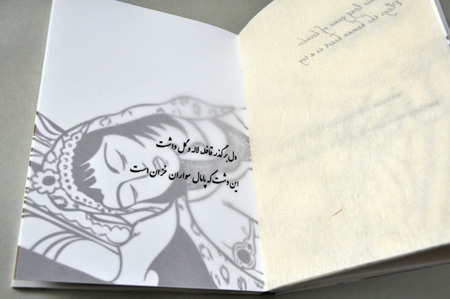
Ala often layers text and image when drawing on his Iranian heritage to create what he describes as “synthetic epics,” visual narratives that are a “crossroad where present day events meet history and mythology.” His graceful lines merge multiple timelines, interpretations and outcomes in which classical Persian references might co-exist with elements of hip-hop culture.

For his first artist’s book project, Ala brought his layering process to the medium through the use of translucent papers. Farsi and English texts read in opposite directions across a 7-panel accordion structure through which his bottom-layer drawings appear. There’s a wonderful multi-generational aspect to this: The Farsi text layer is by Ala’s great uncle, the renowned Iranian poet and scholar H. E. Sayeh. Ala’s mom co-translated text for the English layer, and Ala’s images complete the picture in the final layer.
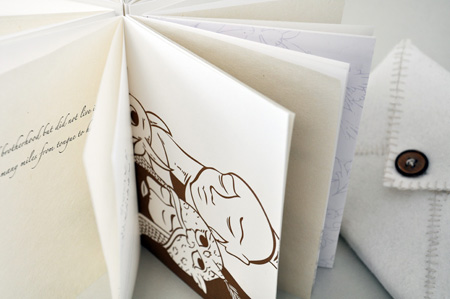
The book displays upright as a closed, continuous star-shaped loop when viewed from above. It features Ala’s blind-embossed Persian motif covers and is housed in a felted, hand-stitched wool pouch.
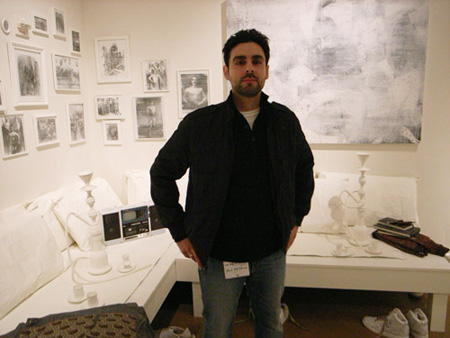
Ala was born in Berkeley in 1978. As a teenager, he worked with Tim Rollins’ seminal group Kids of Survival (K.O.S.) on public art installations and exhibitions around the Bay Area. He later studied traditional Persian painting in Tehran prior to completing his BFA at the San Francisco Art Institute in 2001. He earned his MFA from Stanford University in 2006 and was awarded the Stanford University Paris Studio, during which he participated in a seven-month residency at the Cité des Arts. His work has been exhibited at the M. H. De Young Museum and the 2006 California Biennial at the Orange County Museum of Art, among numerous other venues throughout the U.S., Europe, and the Middle East. He was recently featured in the exhibitions One Way or Another: Asian American Art Now, a touring exhibition originating at the Asia Society in New York, and Bay Area Now 5 at the Yerba Buena Center for the Arts in 2008. He is a visiting lecturer at UC Berkeley and Stanford University and is represented by Gallery Paule Anglim in San Francisco.

Quite an illustrious career for a young guy. Yet for all his great talent and wild success, Ala remains a humble, generous artist and a joy to work with. I’m grateful for having had him on board as resident artist and I value our resulting friendship.

Huge thanks is also owed to our hard-working production manager Rhiannon Alpers and her fabulous team of volunteers, without whom none of this would have been possible.

Come celebrate with us at Ala’s publication party at the San Francisco Center for the Book on Wednesday December 3rd from 7 to 9 P.M. He’ll say a few words about his 2008 residency experience and copies of his beautiful book will be available for purchase. It can also be ordered online, along with the Center’s other fine Imprint publications.

The SFCB is at 300 DeHaro Street (entrance on 16th Street) in San Francisco.
415-565-0545 | www.sfcb.org | imprint@sfcb.org
Permalink  Comments (0)

Antarctica: T-Minus 36 Days

November 24, 2008

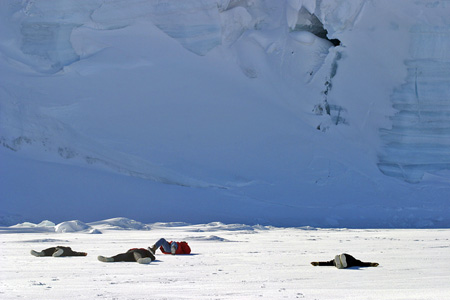
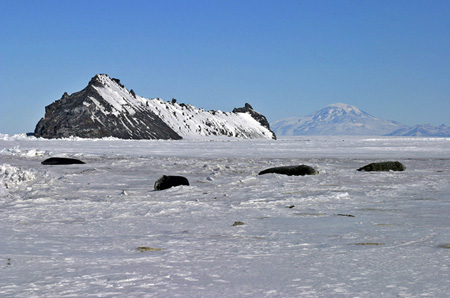
Yes, I’m counting the days. It’s a torturous wait. So until I can post my own photos from the Ice, I’ll post some others. Here’s a nice pair that Henry Kaiser sent my way.

Antarctica: Where man...

Antarctica: Where man...


and seal are indistinguishable.
Photos by Cara Sucher.

and seal are indistinguishable.
Photos by Cara Sucher.

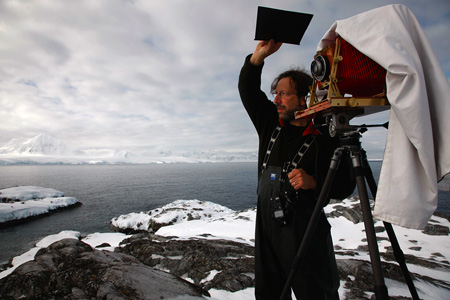
And here’s fellow NSF grantee Scott Sternbach at work at Palmer Station as photographed by his assistant Homero Campos.

These guys are making me jealous.

Permalink  Comments (0)

1000 Journals at SFMOMA

November 20, 2008

Back in elementary school, our class did a memorable experiment where we released dozens of helium-filled balloons into the sky, intending to send them far and wide across the globe. We’d attached postcards to the balloons in hopes that they’d be found and returned from distant lands which we’d locate and mark on our classroom map. Although few (if any) postcards made it back, the project was unforgettable simply for the thrill of casting those balloons to the unknown, allowing our imaginations and expectations to soar with them.

1000 Journals Project creator Someguy surely felt that same thrill when launching a thousand blank books into the world a few years back. But he did the balloons one better. By providing thoroughly democratic, participatory forums that travel hand-to-hand, Someguy brought scores of international collaborators into play. Twice better: he offers a website for participants to scan and upload their contributions to, allowing all to track and view books in circulation — whether or not the actual books ever make it back into Someguy’s hands.

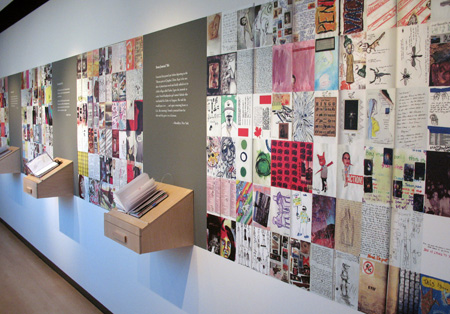
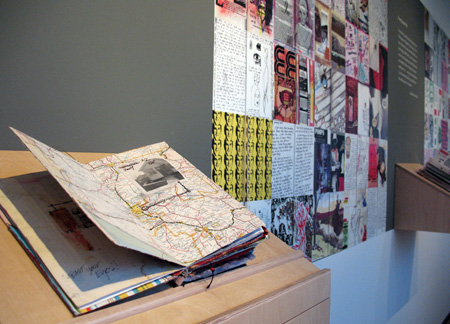
Journals 988 and 805 on display.

Journals 988 and 805 on display.

Fortunately, a number of books did make it back to him, some of which are now on view at the 1000 Journals Project exhibit at the San Francisco Museum of Modern Art. Living up to the project’s tag line “This is an experiment and you are part of it,” the books are displayed for handling and still have blank pages for visitors to add to; pens and pencils are provided. Scans of over 800 contributions are showcased on the gallery walls along with contributors’ quotes and anecdotes about their journal experiences. Among my favorites:

From Journal 323: 

I left the journal on top of a Croatian mountain (Tuhobic) on July 30. I hope that someone who cares will find it…

Update: I visited Tuhobic exactly one year later. The journal was still there. Mountaineers were using it as a sign-in book. So I took it with me and now it is somewhere in Zagreb.

— Zagreb, Croatia

'Scottsdale, AZ / 2004 / 120 degrees' by anonymous contributor to Journal 988.

'Scottsdale, AZ / 2004 / 120 degrees' by anonymous contributor to Journal 988.

Another nice aspect of the 1000 Journals Project are the books’ covers. While the insides are issued blank, the covers are anything but. Someguy embellished each set of 10 journals with unique front and back designs created by himself and various invited artists, effectively announcing the journals’ creative purpose. My design appears on copy numbers 901-910 as seen on this site’s Projects/Exhibitions category as well as on the 1000 Journals site which showcases the complete array of cover contributions.

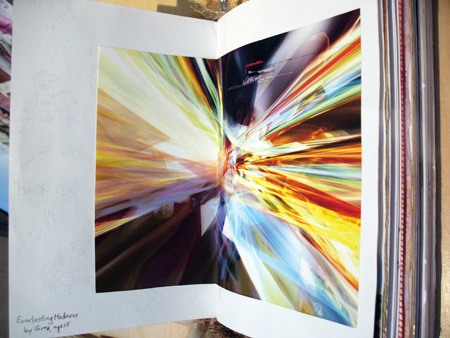
'Everlasting Madness by Greg, age 15' from Journal 550.

'Everlasting Madness by Greg, age 15' from Journal 550.

If you’re as intrigued by this project as I am, you’ll also want to pick up the 1000 Journals compilations book and check out the documentary film screenings at SFMOMA and elsewhere. The exhibition runs alongside SFMOMA’s The Art of Participation show on the second floor through April 5, 2009. 

Permalink  Comments (0)

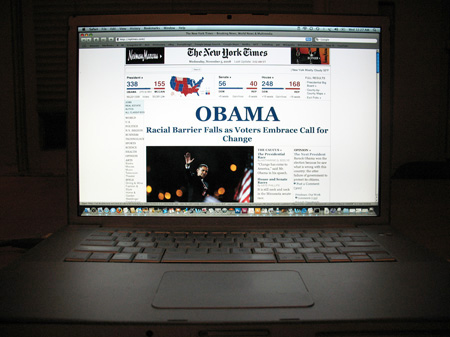
Making History

November 5, 2008

Congratulations, Barack Obama.

Permalink  Comments (0)

Banned and Recovered: Artists Respond to Censorship

November 3, 2008

On any other Election Eve, with all the deserved focus and attention on getting out the vote, I’d be nearly embarrassed to bring up the relatively trivial subject of a little ol’ art show that I happen to be in. But this isn’t any little show, nor is it trivial. In fact it’s so relevant to the election that I wished I’d posted it earlier. It’s titled “Banned and Recovered: Artists Respond to Censorship,” shared by two Bay Area venues: The San Francisco Center for the Book and the African-American Museum and Library at Oakland. The show’s central theme is banned literary works but the title’s operative word is Censorship, which extends from First Amendment topics to civil liberties issues and beyond. Food for thought on this very significant Election Day.

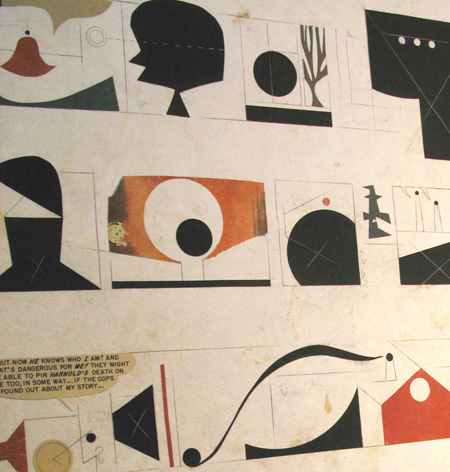
'Comics Code' (detail) on view in Oakland. 
Photograph by Douglas Sandberg.

'Comics Code' (detail) on view in Oakland.
Photograph by Douglas Sandberg.

My contribution to the show is titled “Comics Code,” a cut-paper collage with graphite on Mexican bark paper. The comics I read as a kid bore an official-looking seal on their covers stating approval by the Comics Code Authority. I later learned that the seal originated from the Senate Subcommittee on Juvenile Delinquency hearings in 1954, intending to regulate content deemed harmful to young readers. My piece addresses the Code’s restrictions that ‘sanitized’ the industry to the extent that it put most of the comic titles of the time out of business, which I symbolized by fading the imagery out progressively towards the bottom.

My piece, which can be seen in full on this site’s Works category, draws on EC Comics for its source material. In fact, of all eight of the word balloons comes from a single page of Crime SuspenStories that reads like a metaphor for the impending demise of the genre. (I’ll soon add a hi-res file large enough to read.) The title “Comics Code” works as a double entendre in that it also refers to the iconic visual vocabulary of comics (think ‘speed lines’ and ‘thought balloons’). The notion of such abstract symbols having become universally accepted and understood interests me as much as the tales they tell. Comics are modern-day glyphs, and I arranged my elements compositionally to make that analogy.

“Comics Code” is not an indictment of Dr. Fredric Wertham, whose infamous testimony dealt publishers their final blow at the Hendrickson hearings. (Regardless of Wertham’s views, I support his exercising his First Amendment rights.) Nor is it a judgement call on the content in question. (Clearly much of it was violent.) Nor is it about McCarthyism per se (Communism was not among the charges, as Louis Menand points out in this excellent New Yorker book review), but we’re getting warm. It’s about climates of surveillance encouraging self-censor-ship and environments that deem it unpatriotic to speak out. It’s about lack of due process (First Amendment rights don’t get you far in kangaroo court proceedings — which the Hendrickson hearings are compared to) and about promoting divisiveness in the name of democracy. Personally, my democratic ideals don’t jibe with slogans like “you’re either with us or against us,” and “the real America” to the exclusion of alternate opinions.

To proponents of such doctrines, “Comics Code” answers: No thanks, I’ll be voting with “the other folks” for the restoration of inclusiveness, tolerance, justice, and civil liberties.

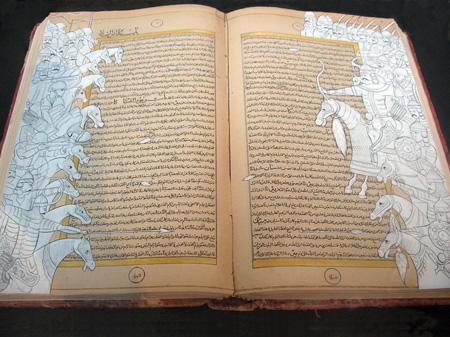
Ala Ebtekar's 'Bound Chasm' at the SFCB.

Ala Ebtekar's 'Bound Chasm' at the SFCB.

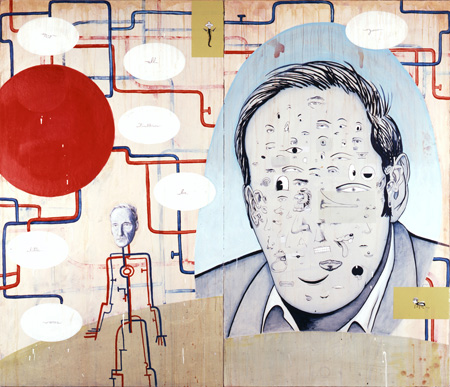
Among my favorites of the exhibition’s sixty or so pieces are Enrique Chagoya’s “Double Portrait of William Burroughs,” Nigel Poor’s “Washed Books,” and Ala Ebtekar’s “Bound Chasm,” all at the San Francisco half of the show, up till November 26 at the S.F. Center for the Book, 300 DeHaro Street (entrance on 16th Street). Gallery hours: M-F 10-5; Sat 12-4.

Enrique Chagoya's 'Double Portrait of William Burroughs' at the SFCB.

Enrique Chagoya's 'Double Portrait of William Burroughs' at the SFCB.

My piece is at the African American Museum and Library at Oakland, a majestic historical landmark building at 659 14th Street. This half of the show is up till December 31. Gallery hours: Tue-Sat, 12-5:30.

“Banned and Recovered: Artists Respond to Censorship” is curated by Hanna Regev in coordination with former SFCB Artistic Director Steve Woodall and AAMLO Director Rick Moss. Thank you all.

See you at the polls.

Permalink  Comments (0)